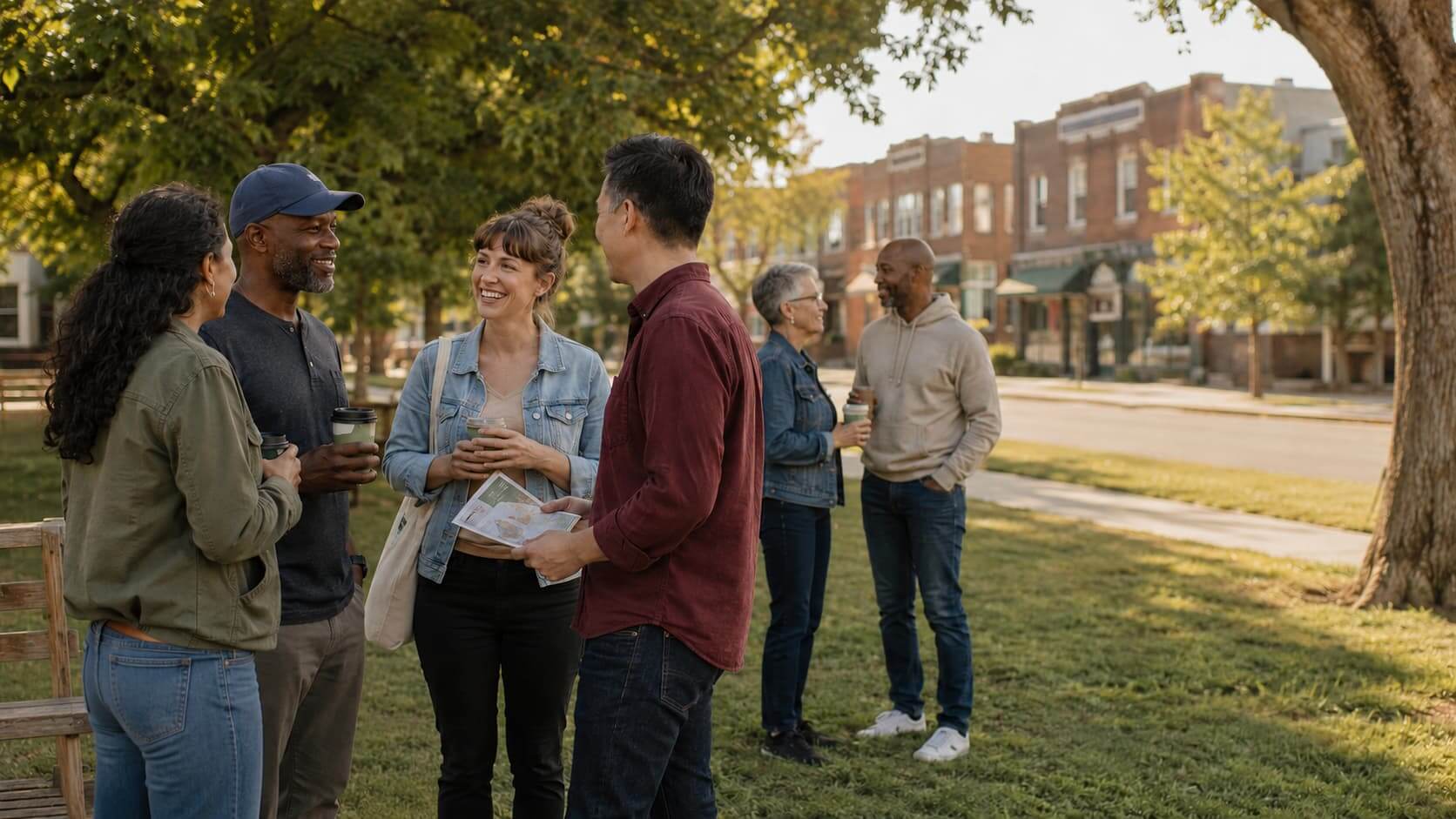
Moving to Omaha gives you a new address, but it does not automatically give you a new social circle. Even people who are comfortable meeting strangers can find that making friends as an adult takes more planning than it did in school. Work may be remote, neighbors may keep different schedules, and a one-time conversation rarely turns into a friendship by itself.
The good news is that Omaha offers plenty of places where people gather repeatedly: neighborhood meetings, running groups, volunteer shifts, recreation leagues, library book clubs, classes, arts events, parent activities, dog parks, and professional programs. The key is not to sample all of them once. It is to choose a few that fit your life, return often enough to become familiar, and take small steps toward seeing the same people outside the original activity.
This guide explains how to build a social life in Omaha from the ground up, whether you arrived alone, with a partner, with children, or with a pet.
Start with the right expectation
A friendly exchange is not the same thing as a friendship. Most adult friendships grow through repeated contact, shared activity, and gradual follow-up. That means the best question is not simply, “Where can I meet people in Omaha?” A better question is, “Where can I see compatible people regularly without rearranging my entire life?”
That distinction matters. A huge festival may introduce you to dozens of people, but a monthly book club, weekly run, or twice-monthly volunteer shift gives you more opportunities to remember names and continue conversations. Look for settings with a predictable schedule and a natural reason to talk.
Give a promising group at least three visits before deciding it is not for you. Attendance changes, first meetings can feel awkward, and regulars may need time to recognize a newcomer. You are evaluating the pattern, not one evening.
Choose activities that fit your actual Omaha routine
Omaha is easy to cross in some directions and slower in others, especially during rush hour, construction, or winter weather. A social plan that requires a long drive across the metro every Tuesday may look appealing on paper and disappear from your calendar after a month.
Before joining anything, consider where you live, where you work, and when you have energy. If you are still choosing an area, the MoveToOmaha neighborhood guides can help you understand the different parts of the metro. If you have already moved, use the commute and parking guide to set realistic boundaries for weeknight plans.
A simple approach is to create three distance zones:
- Close to home: your neighborhood, a nearby library, park, coffee shop, gym, or community center
- Close to work: lunch groups, professional events, fitness classes, or volunteer opportunities near your workplace
- Worth a special trip: a citywide group or activity that strongly matches your interests
Try to place at least one recurring activity in the first zone. Convenience is an underrated friendship tool.
Meet people through your neighborhood
Your immediate area is the most practical place to begin because the people you meet already share something useful with you: geography. Nearby friends are easier to invite for a walk, ask about a local contractor, meet for coffee, or see at a community event.
The City of Omaha maintains an official Neighborhood Directory with neighborhood associations, alliances, and community groups. Search for your area, then look for meeting information, newsletters, cleanup days, block parties, safety events, or public planning discussions. Some groups are more active than others, so check the listed website or social channel for a current calendar before attending.
You do not have to become an officer or attend every meeting. Volunteer for one specific job, such as checking in attendees, setting up chairs, helping with a cleanup, or delivering flyers. A task makes introductions easier because you have an immediate role and a reason to speak with other volunteers.
Also practice low-pressure visibility where you live. Walk at roughly the same time, use the same nearby park, sit on the porch, or visit a regular weekend market. Say hello first. If a conversation goes well, introduce yourself and mention that you recently moved to Omaha. That detail gives the other person an easy opening to offer a recommendation.
Build friendships around running, walking, and recreation
Activity-based groups work well because nobody has to carry the entire conversation. You can talk before or after a run, between games, or while walking a trail. Movement also creates a natural end time, which can make the first visit more comfortable for introverts.
The Omaha Running Club supports local runners and walkers through races, training programs, and community runs. Its free fun runs vary in distance, and the club states that all paces are welcome. Check the current calendar and event details before going. If you prefer to explore independently first, use MoveToOmaha’s guide to the best walking, running, and biking trails, then look for clubs or informal groups that use a trail near you.
For team activities, Omaha Parks and Recreation offers organized adult sports through its City Wide Sports program. Current offerings and registration periods can change, so review the official page rather than relying on an old social post. A recreation league can be especially useful because the season provides repeated contact without requiring you to invent a new plan each week.
Gyms can also become social if you attend the same class consistently. A large facility with dozens of options is not automatically better than a smaller place where staff and participants learn your name. The MoveToOmaha guide to Omaha fitness centers and gyms can help you compare styles. When you tour, ask whether the facility has beginner programs, recurring small groups, member events, or leagues.
Volunteer where the same people return
Volunteering is one of the most reliable ways to meet people whose values overlap with yours. It also reduces the pressure to be socially impressive. Everyone has work to do, conversations arise naturally, and you leave knowing you contributed something useful.
SHARE Omaha is a local nonprofit resource for finding Omaha-area organizations, volunteer openings, and community events. You can search for causes that matter to you and look for opportunities that fit your availability. One-time projects are helpful for testing an organization, but recurring shifts usually create better conditions for friendship.
Use this sequence:
- Choose one cause you genuinely care about.
- Try a single event or orientation.
- If the environment feels right, commit to a recurring shift for two or three months.
- Learn the names of the people on your shift.
- Ask whether volunteers ever meet before or after serving.
Do not select an opportunity only because it sounds social. Pick work you would still find worthwhile on a quiet day. That makes it easier to stay consistent while relationships develop.
Use Omaha Public Library as a social starting point
Libraries are especially useful for newcomers because they are public, low-cost, and designed for repeat visits. Omaha Public Library hosts events for different ages and interests. Its book clubs typically meet monthly at library locations and are facilitated by library staff, which gives first-time participants a clear structure.
Browse the library’s current calendar rather than limiting yourself to book discussions. Look for workshops, talks, technology programs, writing activities, and events at the branch closest to you. Choose one series and return. Staff can often point you toward other programs with similar participants.
Parents can use MoveToOmaha’s guide to library storytimes and free weekly activities. Storytime may be designed for children, but repeated visits also let adults recognize other parents and caregivers. Start with a simple question about the child’s age, the branch, or another local activity. If you keep seeing the same family, suggest meeting at a nearby playground afterward.
Take a class with a beginning and an end
Classes solve two common newcomer problems: they provide a reason to attend and a built-in topic of conversation. They also attract people who chose the same subject, which gives you at least one shared interest from the start.
Metropolitan Community College offers community education classes for personal enrichment and career development. Current categories include creative, culinary, practical, and maker-oriented subjects, although individual classes and schedules change by term. A multi-session class usually offers more social potential than a single lecture.
When choosing a class, ask yourself whether participants will interact or work side by side. A workshop, language practice group, cooking class, or hands-on maker course may create more conversation than a large presentation. Arrive a few minutes early, sit near other people, and ask what brought them to the class.
Use arts and culture events as a bridge, not the finish line
Omaha has many public arts events, performances, gallery openings, and neighborhood festivals. These are excellent places to discover a community, but a crowded event alone may not produce a second meeting. Pair the event with a smaller recurring program.
For example, Benson First Friday brings art, music, and community programming to the Benson Creative District. Go with a purpose beyond walking through the crowd. Attend an artist talk, take a class, volunteer, return to the same gallery, or ask an exhibitor about future workshops. MoveToOmaha’s Benson neighborhood guide can help you get oriented before your first visit.
You can find more ideas in the Omaha events calendar, but resist filling every weekend with unrelated one-off outings. Use major events to identify the communities you want to revisit.
Turn professional networking into genuine connection
Professional events can help remote workers, recent graduates, career changers, and people whose new jobs do not provide much casual interaction. The goal does not have to be collecting contacts. Focus on finding a few people with similar work, interests, or life transitions.
The Greater Omaha Chamber’s Young Professionals program lists programs and events centered on connection, learning, service, and community involvement. MoveToOmaha also maintains a broader guide to job boards and networking groups.
At a networking event, skip the urge to tell everyone your complete career history. Ask where someone moved from, what they enjoy about Omaha, or which local group they would recommend to a newcomer. If you have a good conversation, connect afterward with a short, specific note. Suggest coffee only when there is a clear reason to continue the conversation.
Remote workers can also rotate among a few places from the guide to coffee shops for remote work and casual meetings. A coffee shop is not a guaranteed social club, but becoming a respectful regular can make the city feel more familiar.
Make the most of life-stage connections
If you moved with young children
Children create recurring schedules around daycare, school, sports, storytimes, and playgrounds. Those settings can help parents meet, but you may still need to take the first step. The guide to moving to Omaha with young kids explains what to join first.
Keep early invitations easy: playground after storytime, coffee during practice, or a short family visit to a familiar attraction. Exchange numbers only after a comfortable conversation, and be specific when you follow up. “We will be at the park Saturday around 10 if you want to join” is easier to answer than “We should hang out sometime.”
If you moved with a dog
Dog owners often see the same people on neighborhood walks, at training classes, and in dog parks. The guides to moving to Omaha with pets and Omaha dog parks can help you find suitable places.
Choose a park that matches your dog’s temperament, follow posted rules, and pay attention to the animals before starting a long conversation. If both dogs and people seem comfortable, ask the owner whether they visit on a regular schedule. Familiar walking partners can become friends, but pet safety comes first.
If you moved with a partner
Do not make one person responsible for the couple’s entire social life. Each partner can choose one independent activity and one shared activity. That creates both individual friendships and couple connections. It also prevents every invitation from depending on two schedules matching.
If you moved alone
Solo newcomers may need to be especially deliberate about weekends and holidays. Put recurring plans on the calendar before your workweek fills up. The MoveToOmaha list of 25 places to visit in your first 60 days can help you learn the city, but choose a few visits that can lead to repeated participation rather than treating the list as a checklist.
A practical 30-day friendship plan
You do not need to build a complete social circle in one month. The objective is to create momentum and put future meetings on your calendar.
Week 1: Map your opportunities
- Find your neighborhood association or community group.
- Check the nearest library, park, community center, and trail.
- Choose one interest you already enjoy and one activity you want to learn.
- Identify three recurring groups within a realistic drive.
Week 2: Attend two things
Attend one structured activity and one low-pressure event. Introduce yourself to at least two people at each. You do not need an impressive opening line. “I just moved to Omaha and this is my first time here” is enough.
Week 3: Return and follow up
Go back to the activity that felt most natural. Use names if you remember them. Send one follow-up message to someone you enjoyed meeting, or ask whether the group has another event scheduled.
Week 4: Make one specific invitation
Suggest something small and connected to the original setting: coffee after the run, lunch after volunteering, a visit to another gallery, a playdate after storytime, or practice before the next league game. Include a day, time, and place. If the person cannot attend, do not take one scheduling conflict as rejection.
Conversation starters that work for Omaha newcomers
You do not need to know local history or sports to start talking. Use questions that invite recommendations and personal experience:
- How did you get involved with this group?
- Do you come every week or only for certain events?
- I am new to Omaha. What is one place you think I should visit?
- Is there another local group like this one?
- Which part of the metro do you live in?
- What do you like to do here in winter?
Listen for details you can remember later. The next time you meet, ask about the race, project, child, pet, or neighborhood they mentioned. Friendship grows when people feel recognized, not when every conversation starts from zero.
Common mistakes that slow down the process
Trying too many groups at once
A packed calendar can create many introductions and no continuity. Start with two recurring commitments. Add another only if you can still return consistently.
Waiting for established residents to do all the inviting
People may be warm and still assume you are busy. Make a small, clear invitation instead of waiting for someone to design a plan for you.
Giving up after one awkward visit
Some groups take time to understand. Try three visits unless the environment feels unsafe, unwelcoming, or clearly incompatible with your values.
Joining only newcomer groups
Other recent arrivals understand the transition and may be eager to connect. Longtime residents bring local knowledge and established networks. A healthy mix gives you both.
Overlooking winter logistics
Omaha weather can disrupt plans. Choose at least one indoor activity, confirm events before leaving, and do not pressure anyone to drive when conditions are poor. Use the MoveToOmaha winter guide to prepare for cold-weather routines.
Expecting every connection to become a close friendship
Some people will become activity friends, neighbors you greet, professional contacts, or occasional companions. Those relationships still make a new city feel like home. A few may deepen with time.
Frequently asked questions
What are the best places to make friends in Omaha as an adult?
The best places are recurring, interactive settings that fit your interests and schedule. Good starting points include neighborhood associations, volunteer shifts, recreation leagues, running groups, library book clubs, community education classes, arts programs, parent activities, and professional groups.
How can an introvert meet people in Omaha?
Choose structured activities with a clear task and a small or predictable group. Volunteering, book clubs, classes, walking groups, and maker workshops create natural conversation without requiring constant mingling. Arrive early, when the room is quieter, and plan to speak with one or two people rather than everyone.
What are free or inexpensive ways to meet people?
Neighborhood meetings, library programs, some community runs, volunteer opportunities, public events, parks, and walking groups can be free. Always confirm current registration requirements and costs with the organizer.
How long does it take to make friends after moving?
There is no fixed timeline. Your schedule, personality, life stage, and consistency all matter. Instead of measuring success by the number of close friends you have after a certain month, track whether you are returning to the same places, recognizing people, exchanging invitations, and building a dependable routine.
What if I work from home?
Create social structure outside work before isolation becomes your default. Schedule one weekday activity and one weekend activity, use a coworking or coffee setting occasionally, attend relevant professional events, and consider a recurring volunteer shift.
Where should a newcomer begin this week?
Pick the easiest repeatable option near home. Look up your neighborhood group, check the nearest library calendar, or choose one community run, class, or volunteer opportunity. Put the first event and its next scheduled meeting on your calendar at the same time.
The bottom line
Making friends in Omaha is less about discovering one perfect venue and more about creating repeated chances to connect. Choose activities you would enjoy even before you know anyone, keep the travel realistic, return often, remember names, and make specific invitations.
Your first goal is not an instant best friend. It is a week that includes familiar places, familiar faces, and one plan you are looking forward to. Build that rhythm, and Omaha will start to feel less like the city you moved to and more like your community.


