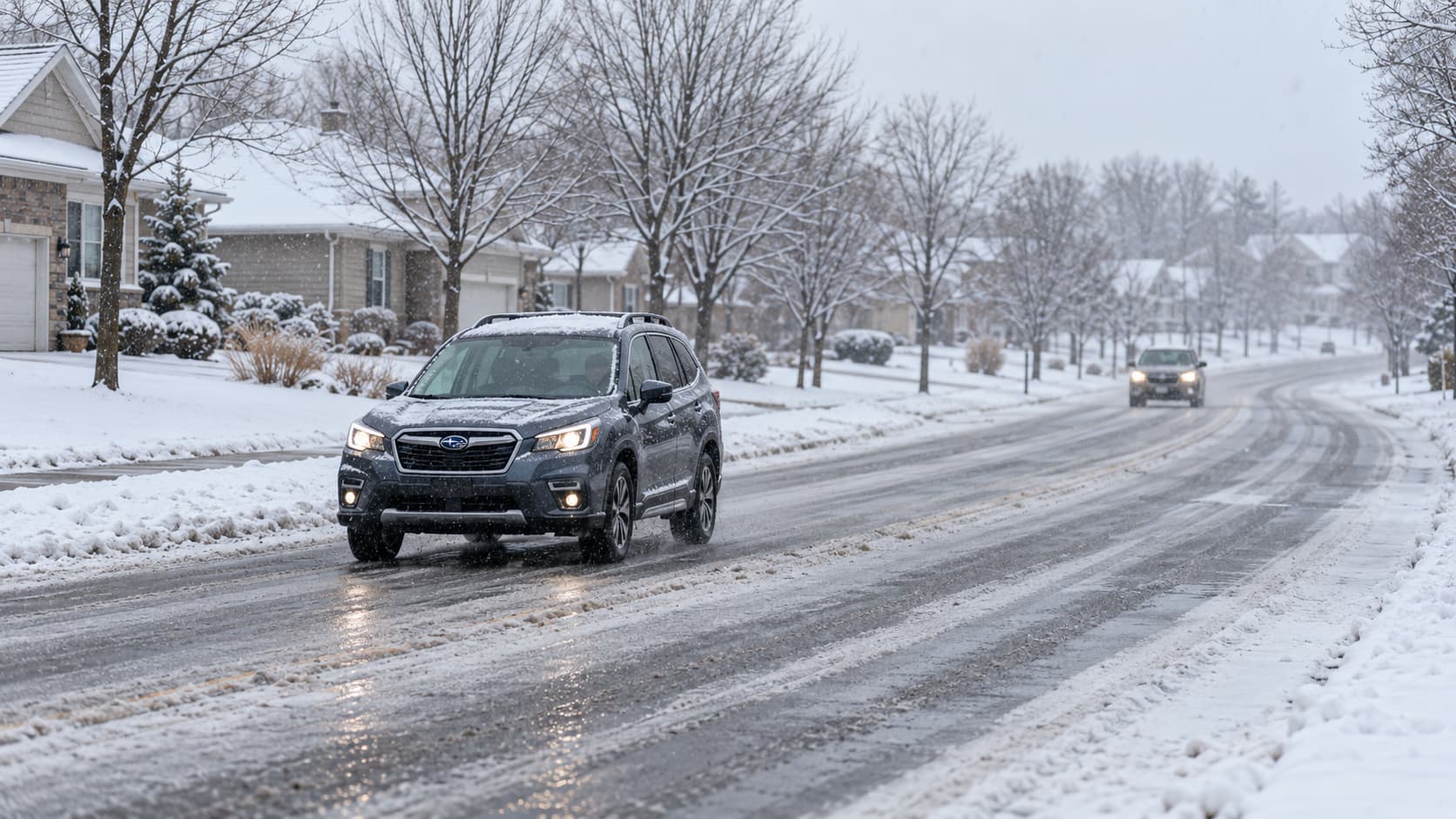
Your first Omaha snowfall can be beautiful right up until it is time to drive to work, take a child to school, or make a grocery run. Roads that looked ordinary the night before may be covered with packed snow, thin ice, slush, or drifting snow by morning.
The good news is that winter driving becomes much more manageable when you know where to check conditions, how Omaha roads are treated, what your vehicle needs, and when staying home is the better decision.
This guide is written for people who are new to Omaha winters, especially those arriving from places where snow and ice are rare. For a broader look at the season, start with our Omaha winter weather guide. If you need information about plowing, snow emergencies, street parking, and sidewalk rules, see our Omaha snow removal guide.
Quick Answer: Is Winter Driving in Omaha Difficult?
Most winter days in Omaha do not require special driving skills. Streets are dry, traffic moves normally, and daily life continues. The challenging periods are usually during a storm, immediately afterward, or when melting snow refreezes.
Your safest approach is simple:
- Check the forecast and road conditions before leaving.
- Give road crews time to work when your trip can wait.
- Clear your entire vehicle before driving.
- Reduce your speed and leave much more following distance.
- Use smooth steering, braking, and acceleration.
- Carry basic winter supplies in the vehicle.
- Change or cancel the trip if conditions exceed your experience or comfort level.
You do not need to become an expert during your first storm. You need a reliable routine and the willingness to slow down.
Check Conditions Before You Leave
A weather app can tell you that snow is falling, but it may not tell you whether your route is partly covered, completely covered, closed, or improving. Before driving, check both the weather and the roads.
Use Nebraska 511 for highways and major routes
Nebraska 511 provides current road conditions, closures, traffic incidents, cameras, and other traveler information for state-maintained roads. It is particularly helpful if your commute includes Interstate 80, Interstate 480, Interstate 680, Highway 75, Highway 370, or another state route.
Look at the full route rather than checking only the area near your home. Conditions can change considerably from one side of the metro to the other, and a road that is merely wet in Omaha may be snow-covered farther west or north.
If your trip crosses the Missouri River into Council Bluffs or continues farther into Iowa, check Iowa 511 as well. Each state maintains its own traveler-information system.
Follow the local National Weather Service office
The National Weather Service office in Omaha/Valley provides forecasts, warnings, winter-weather graphics, and expected travel impacts for eastern Nebraska and southwest Iowa. Pay attention to timing. A morning commute may be uneventful even when an evening commute is expected to become hazardous.
A winter weather advisory should not be interpreted as meaning conditions are harmless. It generally means winter weather is expected to cause travel difficulties or significant inconvenience. A winter storm warning signals more serious conditions that are occurring or expected.
Check school, employer, and service updates separately
Omaha does not have one universal closure decision. School districts, colleges, employers, child-care centers, transit services, and local governments make their own announcements. A school closing does not automatically mean roads are closed, and open roads do not necessarily mean every organization will operate normally.
If you work from home, decide in advance which situations justify avoiding errands. Waiting a few hours can make a major difference after plows and treatment trucks have completed another pass.
Understand the Conditions That Surprise Newcomers
Heavy snowfall is easy to recognize. The more deceptive Omaha driving hazards can be a light glaze, a refrozen patch, or blowing snow crossing an otherwise clear road.
Bridges and overpasses can become slick first
A bridge deck is exposed to cold air above and below, so it can freeze while the nearby pavement remains wet. Approach bridges, overpasses, ramps, and elevated sections with extra caution when temperatures are near or below freezing.
Black ice may look like wet pavement
Black ice is a thin, difficult-to-see layer of ice. It is especially concerning at night, around dawn, on bridges, in shaded areas, and anywhere meltwater has refrozen. If the temperature is below freezing, do not assume a shiny road surface is only wet.
Drifting snow can cover a recently cleared road
Omaha’s wind can move loose snow back across exposed roads. Conditions may be clear for several blocks and then change quickly near an open field, highway interchange, or less-developed edge of the metro. Reduced visibility and drifting are good reasons to reconsider nonessential travel.
Slush can pull at the tires
Deep slush creates resistance and can affect steering. Slow down before entering it, keep a steady grip on the wheel, and avoid abrupt lane changes. Leave extra space around trucks and other vehicles that may throw slush onto your windshield.
Refreezing can create a second round of problems
Sun and traffic may melt snow during the day. If temperatures fall after sunset, that water can freeze again. A road that improved during the afternoon can become slick after dark, even without new precipitation.
Prepare Your Vehicle Before the First Storm
Do not wait for the first icy morning to discover that your battery is weak, your wiper blades smear, or your washer fluid is not suitable for cold weather. A basic fall inspection can prevent an inconvenient breakdown in dangerous temperatures.
Check the tires
Tires affect acceleration, steering, and stopping. Inspect their condition and tread, and check pressure when the tires are cold. Use the pressure recommended by the vehicle manufacturer, normally shown on a label inside the driver’s door or in the owner’s manual, rather than the maximum pressure printed on the tire.
All-season tires may be adequate for many Omaha drivers when they are in good condition and travel can be delayed during the worst weather. Winter tires can provide additional traction in snow and cold conditions. Your driving needs, commute, vehicle, storage space, and ability to stay home during storms all matter.
Four-wheel drive or all-wheel drive can help a vehicle move, but it does not remove the need for safe tires, lower speed, or greater stopping distance. Every vehicle can lose traction on ice.
Test the battery and charging system
Cold weather places extra demand on a conventional vehicle battery. If the battery is older, slow to crank, or of unknown condition, have it tested before winter. Electric and hybrid vehicles can also have reduced driving range in cold weather, so owners should understand their vehicle’s winter range and charging recommendations.
Inspect visibility and heating equipment
Make sure the heater, defroster, headlights, brake lights, and windshield wipers work properly. Fill the reservoir with washer fluid rated for winter temperatures. Keep an ice scraper and snow brush inside the vehicle, not in a garage you may be unable to access from a frozen car.
Keep enough fuel or charge
The Nebraska Department of Transportation recommends keeping at least half a tank of fuel during winter travel. This gives you more flexibility if traffic stops, a route closes, or you must wait safely for help. EV drivers should apply the same planning principle by maintaining an appropriate charge buffer for the conditions and route.
Build a Practical Omaha Winter Car Kit
A winter kit does not need to fill the trunk. Pack supplies appropriate for your passengers, commute, and travel outside the metro.
- Ice scraper and snow brush
- Warm blanket or sleeping bag
- Hat, gloves, and extra warm clothing
- Phone charging cable and charged power bank
- Flashlight with spare batteries
- First-aid kit and necessary medication
- Bottled water and shelf-stable snacks
- Reflective triangles or another visible warning device
- Small shovel
- Traction aid such as sand or nonclumping cat litter
- Jumper cables or a portable jump starter
Add supplies for babies, older adults, pets, or anyone with a medical need. Check the kit each fall, recharge the power bank, replace expired items, and make sure winter clothing still fits.
Clear the Whole Vehicle Before Driving
Give yourself enough time to remove snow and ice from every window, mirror, exterior light, the hood, and the roof. A small clear spot on the windshield is not enough for safe visibility.
Snow left on the hood can blow back onto the windshield. Snow or ice left on the roof can slide forward while braking or blow onto another vehicle. Clear around exterior cameras and driver-assistance sensors according to the vehicle manufacturer’s instructions.
Also remove snow from around the tailpipe before starting or idling a vehicle that has been buried or surrounded by drifting snow. A blocked exhaust can allow carbon monoxide to accumulate.
How to Drive on Snow and Ice
The central rule is to make every input gentler than it would be on dry pavement. Abrupt acceleration, hard braking, and sharp steering can use up the limited traction available.
Slow down before the problem
Posted speed limits are designed for favorable conditions. A safe winter speed may be considerably lower. Reduce speed before curves, ramps, intersections, hills, bridges, and traffic backups rather than braking hard after entering them.
Increase following distance
NDOT advises drivers to significantly increase following distance in winter conditions and describes tripling the normal distance as a useful precaution. More space gives you time to slow gradually and react if the vehicle ahead loses control.
Use smooth control inputs
Accelerate slowly, steer deliberately, and brake earlier than usual. Avoid using cruise control when roads are slippery. Keep both hands available for steering and limit distractions.
Do not rely on the vehicle to defeat physics
Anti-lock brakes, traction control, stability control, and all-wheel drive can help, but none creates traction where little exists. Learn how your vehicle’s systems behave by reading the owner’s manual. Do not test limits on a public road.
If the vehicle begins to skid
Remain calm, ease off the accelerator, and look and steer in the direction you want the front of the vehicle to travel. The National Weather Service advises drivers with anti-lock brakes to apply steady pressure rather than pumping the brake pedal. Because vehicles and conditions differ, follow your owner’s manual and avoid sudden corrections.
Give hills and intersections extra respect
Approach uphill sections with enough controlled momentum to avoid hard acceleration partway up. Increase space behind other vehicles so you do not have to stop unnecessarily on a slick incline. Begin slowing early for downhill stops and intersections.
At a traffic light, remember that cross traffic may not be able to stop as quickly as expected. Even when your light turns green, look for vehicles sliding into the intersection before proceeding.
How to Drive Around Snowplows
A snowplow is working to improve the road in front of you, but the area immediately around it can have poor visibility, flying snow, deicing material, and wide equipment.
- Slow down as soon as you see a plow.
- Stay well behind it and out of its blind spots.
- Do not follow inside the cloud of snow.
- Never pass a plow on the right. Some plows have a wing extending on that side.
- Be patient if a plow occupies more than one lane or turns at a median crossover.
- Do not assume the lane beside the plow is safer than the lane it has cleared.
NDOT notes that plows generally travel slowly and need extra room to work. Arriving a few minutes later is better than creating a collision that blocks the road for everyone.
Plan an Easier Winter Commute
Your normal summer route may not be your best winter route. A longer path using major streets may receive treatment and plowing sooner than a shortcut through residential streets.
Before winter:
- Identify a primary route and an alternative route.
- Notice steep hills, sharp curves, bridges, and exposed sections.
- Learn which parts of the trip are city streets and which are state highways.
- Know where you could safely stop if conditions deteriorate.
- Discuss remote-work, delayed-arrival, and school-closure expectations before a storm.
If you are still learning the metro, our guide to navigating Omaha streets explains the local grid and street naming patterns. The Omaha commute and parking guide can also help you understand everyday travel patterns.
What to Do if You Become Stranded
If your vehicle becomes stuck during a winter storm, call for help when possible and share your location. Unless the vehicle is in an immediately dangerous location, staying with it generally provides shelter and makes you easier to find than walking into blowing snow.
The National Weather Service recommends these precautions:
- Stay in the vehicle.
- Keep the exhaust pipe clear of snow.
- Run the engine only periodically for heat rather than continuously.
- Open a window slightly on the side sheltered from the wind while the engine is running.
- Use flashers, a dome light, or a bright cloth to make the vehicle visible.
- Move your arms and legs periodically, but avoid overexertion.
Carbon monoxide is odorless and dangerous. If the exhaust system may be damaged or the tailpipe cannot be kept clear, do not rely on the engine for heat.
Official Resources to Save Before Winter
Bookmark these sources while the weather is calm:
- Nebraska 511 for state-road conditions, cameras, incidents, and closures
- Iowa 511 for trips into Council Bluffs and elsewhere in Iowa
- National Weather Service Omaha/Valley for local forecasts and winter alerts
- NDOT Winter Driving Safety for vehicle preparation, road safety, and snowplow guidance
- NHTSA Winter Driving Tips for vehicle and tire preparation
For city plowing and snow-emergency information, use the official links in our snow removal, parking, and sidewalk guide. That article also explains why an Omaha mailing address does not always mean the City of Omaha maintains your street.
Your First Omaha Snowfall Checklist
When the forecast calls for snow or ice, work through this list:
- Review the forecast timing and expected impacts.
- Check Nebraska 511 or Iowa 511 for the full route.
- Confirm school, work, transit, and appointment changes.
- Move the vehicle if a snow emergency or parking restriction applies.
- Make sure the fuel tank or battery has a comfortable reserve.
- Place the scraper, winter kit, phone charger, and warm clothing in the vehicle.
- Leave early enough that you will not feel pressure to drive quickly.
- Clear all snow and ice from the vehicle.
- Use major treated roads when practical.
- Cancel or delay the trip if conditions are beyond your experience.
Winter Driving Gets Easier With a Routine
Omaha winter driving is less intimidating once you stop treating every snowfall as the same event. A dusting, freezing drizzle, blowing snow, and a major winter storm create different risks. The forecast, road conditions, temperature, wind, time of day, and route all matter.
Prepare the vehicle before winter, keep a small emergency kit ready, check official information before leaving, and give yourself permission to wait when the road is unsafe. Those habits will carry you through most Omaha winters with much less stress.
If you recently arrived, our first 30 days in Omaha guide can help with the rest of your settling-in checklist. Welcome to Omaha, and take the first snow one careful trip at a time.